![CSS-CMYK-logo-2015-2.png]](https://go.christiansteven.com/hs-fs/hubfs/social-suggested-images/CSS-CMYK-logo-2015-2.png?height=40&name=CSS-CMYK-logo-2015-2.png)
Before You Begin
Before creating an SSRS report in IntelliFront BI, ensure the following requirements are met:
- SSRS Server Access: You have access to a configured SQL Server Reporting Services (SSRS) server containing the reports you want to use.
- SSRS Credentials: You have valid credentials with permission to access and execute the required SSRS reports.
- SSRS Account: If you plan to use an existing SSRS account in IntelliFront BI, ensure that the account has already been configured and is available for selection.
- IntelliFront BI Permissions: Your IntelliFront BI user account has the necessary permissions to create and manage SSRS reports.
- Network Connectivity: The IntelliFront BI server can communicate with the SSRS server.
Note: If you do not have an SSRS account configured in IntelliFront BI, you may be able to enter your SSRS connection credentials directly during report setup, depending on your configuration.
Accessing SSRS Reports in IntelliFront BI
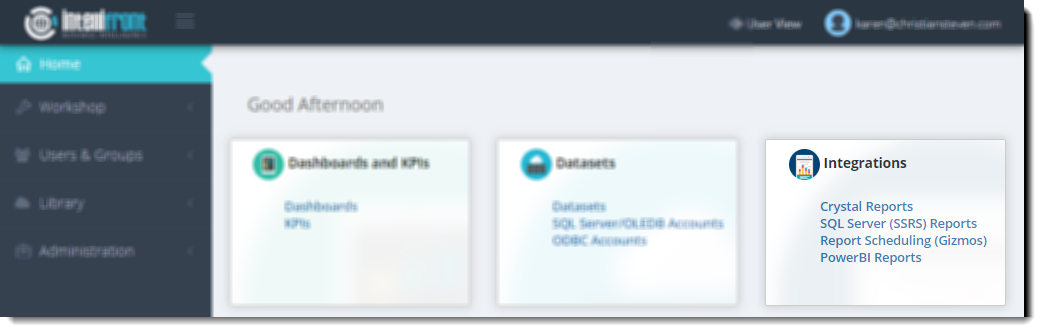
There are two ways to access SSRS Reports in IntelliFront BI: through the Workshop navigation menu or directly from the Home screen.
Option 1: Access SSRS Reports from the Workshop
- Log in to the IntelliFront BI Web Application.
- From the left-hand navigation menu, expand Workshop.
- Select Integrations to display the available reporting integrations.
- Click SSRS Reports.

Option 2: Access SSRS Reports from the Home Screen
- Navigate to the IntelliFront BI Home screen.
- Locate the Integrations card.
- Click SQL Server (SSRS) Reports.
Creating a New SSRS Report in IntelliFront BI
Once you have accessed the SSRS Reports section, you can create a new report by connecting IntelliFront BI to an existing SQL Server Reporting Services (SSRS) report.
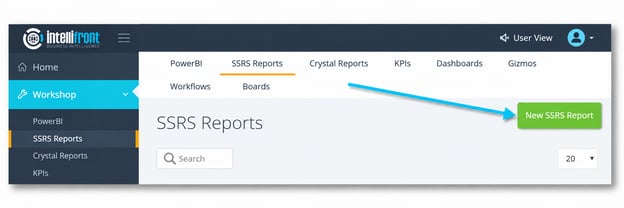
- Navigate to Workshop → Integrations → SSRS Reports, or select SQL Server (SSRS) Reports from the Home screen.
- Click New SSRS Report in the upper-right corner of the SSRS Reports page.
- The new SSRS Report configuration screen opens, allowing you to configure the connection and report settings.
You can now proceed with configuring the SSRS connection and selecting the report you want to make available in IntelliFront BI.
Configuring the SSRS Connection
The SSRS Credentials section allows you to connect IntelliFront BI to your SSRS server using an existing SSRS account or by entering connection credentials manually.
There are two available connection methods:
- Pick Account: Select an SSRS account that has already been configured in IntelliFront BI.
- SSRS Credentials: Enter the SSRS server connection details and credentials directly.
Option 1: Connect Using an Existing SSRS Account
- In the SSRS Credentials section, select Pick Account.
- Open the Select Account dropdown.
- Select the SSRS account you want to use.
- Click Connect to establish the connection to the SSRS server.
Once connected, IntelliFront BI allows you to continue configuring the SSRS report.

Option 2: Connect Using SSRS Credentials
If you prefer to enter the connection details manually:
- Select the SSRS Credentials tab.
- Enter the required SSRS server connection information and credentials.
- Click Connect to establish the connection.
Note: Ensure the selected account or credentials have the necessary permissions to access the SSRS reports you intend to use.


Assigning Groups
The Groups section allows you to associate the SSRS report with user groups in IntelliFront BI.
- Click the Add groups... field.
- Select the group or groups that should have access to the SSRS report.
- Confirm the required groups have been added.
Group access helps control which users can access the report within IntelliFront BI.
Important: Before selecting Save Report, complete the remaining report configuration settings described in the following sections.

Selecting and Loading an SSRS Report
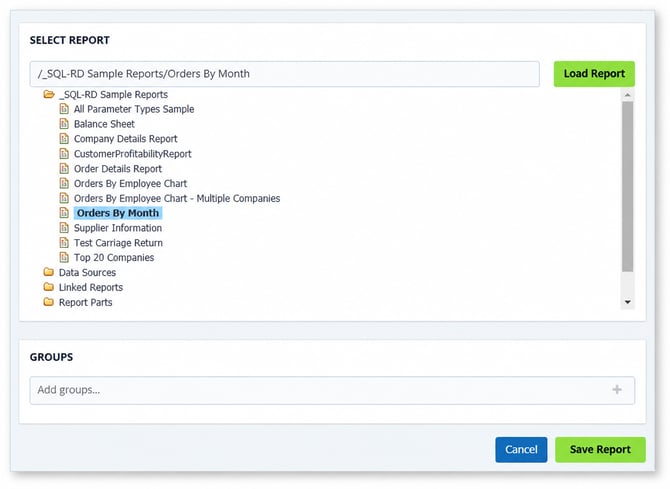
After establishing a successful connection to the SSRS server, IntelliFront BI displays the available reports in the Select Report section.
Select an SSRS Report
- In the Select Report section, expand the SSRS folders to browse the available reports.
- Locate the report you want to add to IntelliFront BI.
- Click the report name to select it.
- Verify that the selected report's path appears in the field above the report list.
- Click Load Report to load the selected report and continue with its configuration.
Assign User Groups
The Groups section allows you to specify which IntelliFront BI user groups can access the selected report.
- Click the Add groups... field.
- Select the group or groups you want to associate with the report.
- Verify that the required groups have been added.
Note: Ensure that the selected groups have the appropriate permissions to access the report and its associated data.
Save the Report
The Save Report button is available at the bottom of the configuration screen.
Before saving, ensure that you have loaded the required SSRS report and completed any additional configuration settings.
Click Save Report when the report is fully configured.
Configuring SSRS Report Parameters
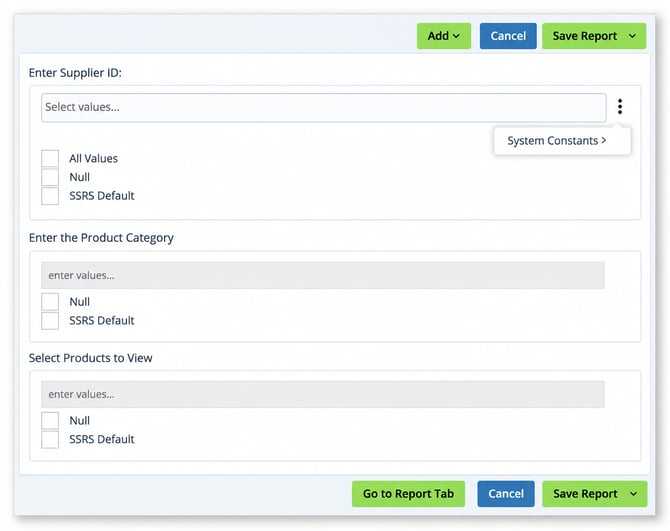
If the selected SSRS report contains parameters, IntelliFront BI displays the available parameter fields.
Parameters allow you to customize the report output by specifying values such as supplier IDs, product categories, date ranges, or other criteria defined within the original SSRS report.
The parameters available depend on how the report was designed in SQL Server Reporting Services.
Setting Parameter Values
- Review the available parameters displayed on the configuration screen.
- Click the appropriate parameter field to enter or select a value.
- Where applicable, select one or more values from the available options.
- Repeat the process for each parameter you want to configure.
- Once the required parameters have been configured, click Go to Report Tab to return to the main report configuration screen.
Understanding the Parameter Options
Depending on the parameter type and the SSRS report configuration, the following options may be available:
| Option | Description |
|---|---|
| All Values | Selects all available values for a parameter, where supported. |
| Null | Passes a null value to the parameter, provided the SSRS report allows null values. |
| SSRS Default | Uses the default parameter value defined in the original SSRS report. |
| System Constants | Provides access to IntelliFront BI system constants that can be used as parameter values, where supported. |
Using System Constants
For supported parameters, IntelliFront BI provides access to System Constants, allowing parameter values to be populated dynamically rather than entered manually.
- Locate the parameter you want to configure.
- Click the three-dot menu beside the parameter field.
- Select System Constants.
- Choose the appropriate constant from the available options.
The selected constant can then be used when the report is executed.
Note: The available parameter options depend on the parameter's data type and the settings defined in the original SSRS report. Not all options are available for every parameter.
Saving the Report
Once the parameters have been configured, you can select Save Report to save the report configuration.
Alternatively, click Go to Report Tab to return to the main report configuration screen before saving.
Viewing and Managing Saved SSRS Reports
After clicking Save Report, IntelliFront BI returns to the SSRS Reports page, where the saved report is displayed as a report card.
Each report card provides quick access to the report and its management options.

Understanding the SSRS Report Card
The report card displays the following information:
- Report Name: Identifies the saved SSRS report. In this example, the report is named Supplier.
- Last Modified: Displays the date and time the report was last modified.
- More Options (three-dot menu): Provides access to additional actions for managing the report.
Accessing a Saved SSRS Report
- Navigate to Workshop → Integrations → SSRS Reports.
- Locate the required report card.
- Click the report to open it.
You can also use the Search field to locate a specific report when multiple reports are available.
Managing SSRS Reports Using the Context Menu
IntelliFront BI provides a context menu for each saved SSRS report, allowing you to edit, view, or delete reports directly from the SSRS Reports page.
Accessing the Context Menu
- Navigate to Workshop → Integrations → SSRS Reports.
- Locate the SSRS report you want to manage.
- Click the three-dot menu in the upper-right corner of the report card.
- Select the required action.
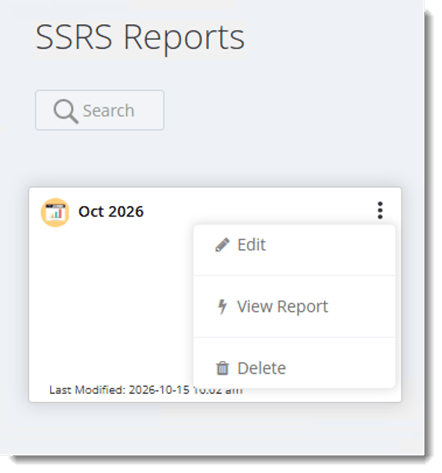
Available Context Menu Options
| Option | Description |
|---|---|
| Edit | Opens the existing SSRS report configuration, allowing you to modify its settings, parameters, or assigned groups. |
| View Report | Allows you to view the selected report using either the SSRS Report Viewer or the IntelliFront BI Viewer. |
| Delete | Removes the saved SSRS report from IntelliFront BI. |
Editing an Existing SSRS Report
- Click the three-dot menu on the required report card.
- Select Edit.
- Update the required report settings.
- Click Save Report to save your changes.
Viewing SSRS Reports in IntelliFront BI
IntelliFront BI provides two options for viewing SSRS reports: the SSRS Report Viewer and the IntelliFront BI Viewer.
Both options allow you to access the selected SSRS report, but they use different viewing interfaces.

Accessing the Report Viewer
- Navigate to Workshop → Integrations → SSRS Reports.
- Locate the report you want to view.
- Click the three-dot menu on the report card.
- Select View Report.
- Choose either SSRS Report Viewer or IntelliFront BI Viewer.
Option 1: SSRS Report Viewer
The SSRS Report Viewer allows you to view the selected report using the SQL Server Reporting Services viewing interface.
This option is useful when you want to work with the report through its native SSRS viewing experience.
Depending on the report configuration, you may be able to enter parameter values, navigate between report pages, and use the viewing options provided by SSRS.
Option 2: IntelliFront BI Viewer

The IntelliFront BI Viewer allows you to choose:
- Export Format: Choose a format to view your report in.
- Send Email Notification to: Enter an email address to receive a notification that the report is ready to view
When the report is ready you can view the selected SSRS report within the IntelliFront BI viewing interface.
This option provides an alternative way to access SSRS report content through IntelliFront BI.
Available viewing controls and functionality may vary depending on the report configuration.
Choosing a Report Viewer
| Viewer | Description |
|---|---|
| SSRS Report Viewer | Displays the report using the native SQL Server Reporting Services viewing interface. |
| IntelliFront BI Viewer | Displays the report using the IntelliFront BI viewing interface. |
Note: The available report parameters, viewing controls, and export options may differ between the two viewers and depend on the configuration of the selected SSRS report.
Depending on the report configuration, you may be prompted to provide parameter values before the report is displayed.
Deleting an SSRS Report
- Click the three-dot menu on the report card.
- Select Delete.
- Follow any confirmation prompts to complete the deletion.
Important: Deleting a report from IntelliFront BI removes its saved configuration within the application. It does not delete the original report from the SQL Server Reporting Services (SSRS) server.
Troubleshooting SSRS Reports in IntelliFront BI
If you encounter issues when creating, configuring, or viewing SSRS reports in IntelliFront BI, review the following common problems and recommended solutions.
Unable to Connect to the SSRS Server
If IntelliFront BI cannot establish a connection to the SSRS server:
- Verify that the SSRS server is running and accessible from the IntelliFront BI server.
- Confirm that the selected SSRS account or manually entered credentials are correct.
- Ensure the account has the necessary permissions to access the SSRS server.
- Check that the SSRS server URL is correct and that network or firewall restrictions are not blocking the connection.
- If using a previously configured SSRS account, verify that its connection settings are still valid.
SSRS Reports Are Not Displayed
If the expected reports do not appear after connecting:
- Confirm that you are connected to the correct SSRS server.
- Expand the available folders to locate the required report.
- Verify that the SSRS account has permission to access the report and its folder.
- Confirm that the report exists and is accessible directly from the SSRS server.
Unable to Load an SSRS Report
If selecting Load Report does not load the selected report:
- Confirm that the report is accessible from the SSRS server.
- Verify that the SSRS account has permission to execute the report.
- Check whether the report requires parameters or access to additional data sources.
- Test the report directly in SSRS to determine whether the issue is specific to IntelliFront BI.
SSRS Report Parameters Are Not Working
If a report does not return the expected results or displays a parameter-related error:
- Verify that all required parameters have valid values.
- Confirm that the selected values match the parameter types defined in SSRS.
- If using SSRS Default, verify that the original report has valid default parameter values.
- If using System Constants, confirm that the selected constant is appropriate for the parameter.
- Check whether the parameter allows multiple values or null values.
Unable to View an SSRS Report
If a saved report does not open in the SSRS Report Viewer or IntelliFront BI Viewer:
- Confirm that the report is still available on the SSRS server.
- Verify that the configured SSRS credentials remain valid.
- Check that any required report parameters have been supplied.
- Try opening the report using the alternative viewer to determine whether the issue is specific to one viewing interface.
- Confirm that the report executes successfully when accessed directly through SSRS.
Users Cannot Access an SSRS Report
If a user cannot access a report that has been added to IntelliFront BI:
- Verify that the user belongs to an IntelliFront BI group associated with the report.
- Review the groups assigned to the report in its configuration settings.
- Confirm that the SSRS connection account has the necessary permissions to access the report.
- Ensure that the user has the appropriate IntelliFront BI permissions to access the relevant reporting functionality.
Unable to Save Changes to an SSRS Report
If changes to an existing report cannot be saved:
- Verify that you have permission to edit the report.
- Confirm that the SSRS connection is valid.
- Review the configured report parameters for missing or invalid values.
- Ensure that the required report configuration settings have been completed before selecting Save Report.
Need Additional Help?
If you continue to experience issues or require further assistance, please log a support ticket. Our Support Team will be happy to assist you.
When submitting a support request, please include the following information where possible:
- The IntelliFront BI version and build number.
- A description of the issue and the steps taken before it occurred.
- Any error messages displayed.
- Whether the issue occurs with all SSRS reports or only a specific report.