![CSS-CMYK-logo-2015-2.png]](https://go.christiansteven.com/hs-fs/hubfs/social-suggested-images/CSS-CMYK-logo-2015-2.png?height=40&name=CSS-CMYK-logo-2015-2.png)
Before You Begin
Before changing the General options:
- Make sure you have access to Options in PBRS.
- Review existing settings before making changes, particularly in environments with multiple PBRS installations.
- If multiple PBRS clients share the same database, be aware that some settings can affect or synchronize behavior across those clients.
- If you are changing a setting to troubleshoot an issue, record its current value so it can be restored if necessary.
Important: Some options affect application-wide behavior, report execution, error handling, or other PBRS users. Only change settings when you understand how they will affect your environment.
Open the General Options
- Open PBRS.
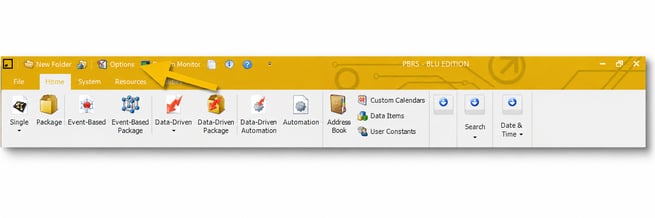
- From the PBRS main menu, select Options.
- Select General.
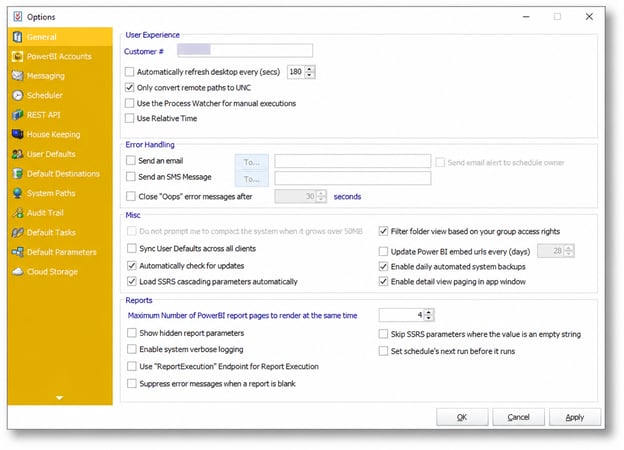
- The General options screen opens.
The settings are organized into four areas:
- User Experience
- Error Handling
- Misc.
- Reports
Open General options
1. Select Options at the top of PBRS.
2. Select General.
Use the General tab to configure user experience, error handling, miscellaneous system behavior, reporting behavior, and Process Watcher settings. Review changes carefully because several options affect all users or scheduled processing.
Configure the User Experience Options
The User Experience section controls general behavior when working in the PBRS desktop application.
The following options are available:
Customer #
Displays the customer number associated with the PBRS installation.
Automatically refresh desktop every (secs)
Automatically refreshes the PBRS desktop at the specified interval.
- Check the option to enable automatic refreshing.
- Enter the refresh interval in seconds.
- In the example shown, the interval is set to 180 seconds.
This can be useful when multiple users or processes are making changes and you want the PBRS desktop to periodically display the latest information.
Only convert remote paths to UNC
When enabled, PBRS converts remote network paths to UNC (Universal Naming Convention) paths where required rather than converting local paths.
This option can be useful in environments where PBRS services or other users need to access resources stored on network locations.
Use the Process Watcher for manual executions
When enabled, PBRS uses the Process Watcher when schedules are executed manually.
This provides additional monitoring of the execution process when a schedule is run manually from PBRS.
Use Relative Time
Enables PBRS to display applicable time information using relative time rather than only absolute date and time values.
For example, applicable information may be displayed relative to the current time instead of solely as a specific timestamp.
Note: User Experience settings affect how PBRS behaves or displays information when you work in the application. Review the current configuration before changing these settings, particularly on shared PBRS installations.
Configure the Error Handling Options
The Error Handling section controls how PBRS notifies users when errors occur and how long certain error messages remain displayed.
Send an email
Enable this option to send an email notification when an error occurs.
- Check Send an email.
- Select To... to specify the recipient or recipients who should receive the notification.
- Where applicable, check Send email alert to schedule owner to also notify the owner of the affected schedule.
Send an SMS Message
Enable this option to send an SMS notification when an error occurs.
- Check Send an SMS Message.
- Select To... to specify the recipient or recipients who should receive the SMS notification.
Close "Oops" error messages after
Controls how long PBRS displays an "Oops" error message before automatically closing it.
- Check Close "Oops" error messages after.
- Enter the number of seconds the message should remain displayed.
- PBRS automatically closes the message after the specified period.
Tip: Configure error notifications for recipients who are responsible for monitoring or maintaining PBRS. This can help ensure that schedule or system errors are identified promptly.
Configure the Miscellaneous Options
The Misc section contains additional system-wide settings that control PBRS maintenance, user access, updates, backups, and application behavior.
Sync User Defaults across all clients
Synchronizes configured User Defaults across PBRS clients.
Enable this option when users working from multiple PBRS clients should use the same User Default configuration.
Automatically check for updates
Allows PBRS to automatically check whether software updates are available.
Load SSRS cascading parameters automatically
When enabled, PBRS automatically loads cascading parameters for SSRS reports.
Cascading parameters are parameters whose available values depend on the selection made in another parameter. Enabling this option allows PBRS to retrieve the appropriate dependent values automatically.
Filter folder view based on your group access rights
Restricts the folders displayed to a user based on the access rights assigned to their group.
Enable this option when you want the PBRS folder view to reflect the user's configured group permissions.
Update Power BI embed URLs every (days)
Allows PBRS to periodically update stored Power BI embed URLs.
- Check Update Power BI embed urls every (days).
- Enter the number of days between updates.
Enable daily automated system backups
Enables PBRS to perform an automated system backup each day.
Important: Automated backups help protect the PBRS configuration, but they should form part of your wider backup and recovery strategy rather than being the only backup of the PBRS environment.
Enable detail view paging in app window
Enables paging when displaying information in detailed views within the PBRS application. This can make larger sets of information easier to navigate by displaying them across pages.
Note: Some options may be unavailable or greyed out depending on the PBRS configuration or environment.
Configure the Reports Options
The Reports section contains settings that control how PBRS processes and executes Power BI and SSRS reports.
Maximum Number of PowerBI report pages to render at the same time
Specifies the maximum number of Power BI report pages PBRS can render concurrently.
Increasing this value may allow more pages to be processed simultaneously but can also increase the resources required by the PBRS server.
Show hidden report parameters
When enabled, PBRS displays report parameters that would otherwise be hidden.
This can be useful when configuring or troubleshooting reports that rely on hidden parameters.
Enable system verbose logging
Enables more detailed system logging for diagnostic and troubleshooting purposes.
Important: Verbose logging should generally be enabled when additional diagnostic information is required. Because it generates more detailed log information, review whether it is still required after troubleshooting is complete.
Use "ReportExecution" Endpoint for Report Execution
When enabled, PBRS uses the ReportExecution endpoint when executing applicable reports.
This setting should normally only be changed when required for the report server configuration or when directed by ChristianSteven Support.
Suppress error messages when a report is blank
Prevents PBRS from displaying an error message when a report returns no report content.
Enable this option when a blank report is an acceptable result and should not be treated as an error.
Skip SSRS parameters where the value is an empty string
When enabled, PBRS does not pass an SSRS parameter when its configured value is an empty string.
This can be useful when the report should handle the absence of a parameter rather than receiving an empty value.
Set schedule's next run before it runs
When enabled, PBRS sets the schedule's next scheduled execution time before the current execution begins.
This can be useful for ensuring that the next-run information is established before report processing starts.
Important: Settings in the Reports section can affect report execution across PBRS. If you are changing one of these options to resolve a specific report issue, test the affected schedules after applying the change.
Apply and Save the General Options
After reviewing or changing the settings in Options > General, save the configuration before closing the Options window.
- Review the settings you have changed.
- Select Apply to save the changes while keeping the Options window open.
- Select OK to save the changes and close the Options window.
- Select Cancel if you want to close the window without applying unsaved changes.
Important: Some General options affect system-wide PBRS behavior. After changing settings related to report execution, error handling, user access, or other system functions, verify that PBRS continues to operate as expected.
Verify the Changes
After applying the settings:
- Return to the PBRS main screen.
- Test the feature or behavior affected by the setting you changed.
- If the change relates to report processing, manually Execute an appropriate test schedule.
- Confirm that the report executes and is delivered as expected.
- If unexpected behavior occurs, return to Options > General and review the setting.
- Check the PBRS Error Log if an error occurs
Related documentation
Troubleshooting
A General Option Is Greyed Out or Cannot Be Selected
Possible cause:
Some General options may only be available when the required PBRS feature or configuration is present.
Resolution:
- Confirm that the required feature is configured in PBRS.
- Check whether the option depends on another setting being enabled first.
- Confirm that you are using the expected PBRS build.
- Do not attempt to change a greyed-out option unless the required functionality is configured.
Changes to General Options Are Not Saved
Possible cause:
The Options window may have been closed without applying the changes.
Resolution:
- Return to Options > General.
- Make the required change.
- Select Apply to save the change while keeping the Options window open, or select OK to save the change and close the window.
- Reopen Options > General and confirm that the setting was retained.
A General Option Does Not Appear in PBRS
Possible cause:
The option may not be available in the PBRS build currently installed.
Resolution:
- Check the PBRS build currently installed.
- Compare the available settings with the documentation for your version.
- Review the PBRS release notes to determine whether the option was introduced or changed in a later build.
- Upgrade PBRS if the required functionality is only available in a newer supported build.
General Options Differ Between PBRS Installations
Possible cause:
The PBRS installations may be running different builds or may have different configurations.
Resolution:
- Compare the PBRS build on each installation.
- Review Options > General on each installation.
- Check whether Sync User Defaults across all clients is appropriate for your environment.
- Do not assume that all General settings are synchronized between separate PBRS environments.
A Setting Has Been Changed but the Expected Behavior Has Not Changed
Possible cause:
The setting may not have been applied, or the affected operation may need to be run again before the change can be observed.
Resolution:
- Confirm that the correct General option was changed.
- Select Apply or OK.
- Repeat the operation affected by the setting.
- Where applicable, close and reopen PBRS and test again.
- Check the PBRS Error Log if an error occurs.
Need Additional Help?
If you cannot change a General option, a setting does not save, or PBRS does not behave as expected after applying a setting, record the PBRS build number, the General option being changed, the expected behavior, and any error messages displayed.
Include screenshots of Options > General where appropriate when submitting your support request.