

Power BI Automation Without Power Automate
Automate Power BI Exports Without Power Automate

Go beyond basic report exports. PBRS schedules or triggers Power BI workflows, generates recipient-specific reports and packages, assembles them into the required files and delivers them with built-in security, monitoring and exception handling—without building and maintaining complex Power Automate flows.
Create standard or data-driven packages with recipient-specific reports, filters, formats, security settings and destinations.
Merge reports into one bookmarked PDF or tabbed Excel workbook, create a ZIP file or send multiple attachments in one email.
Export summary or underlying visual data to formatted or data-only Excel, with data-only PDF options where supported.
Run workflows on schedules or business events with dataset refresh, failure notifications, configured retries and execution history.
The Power Automate Challenge
When Power BI Report Automation Becomes a Development Project
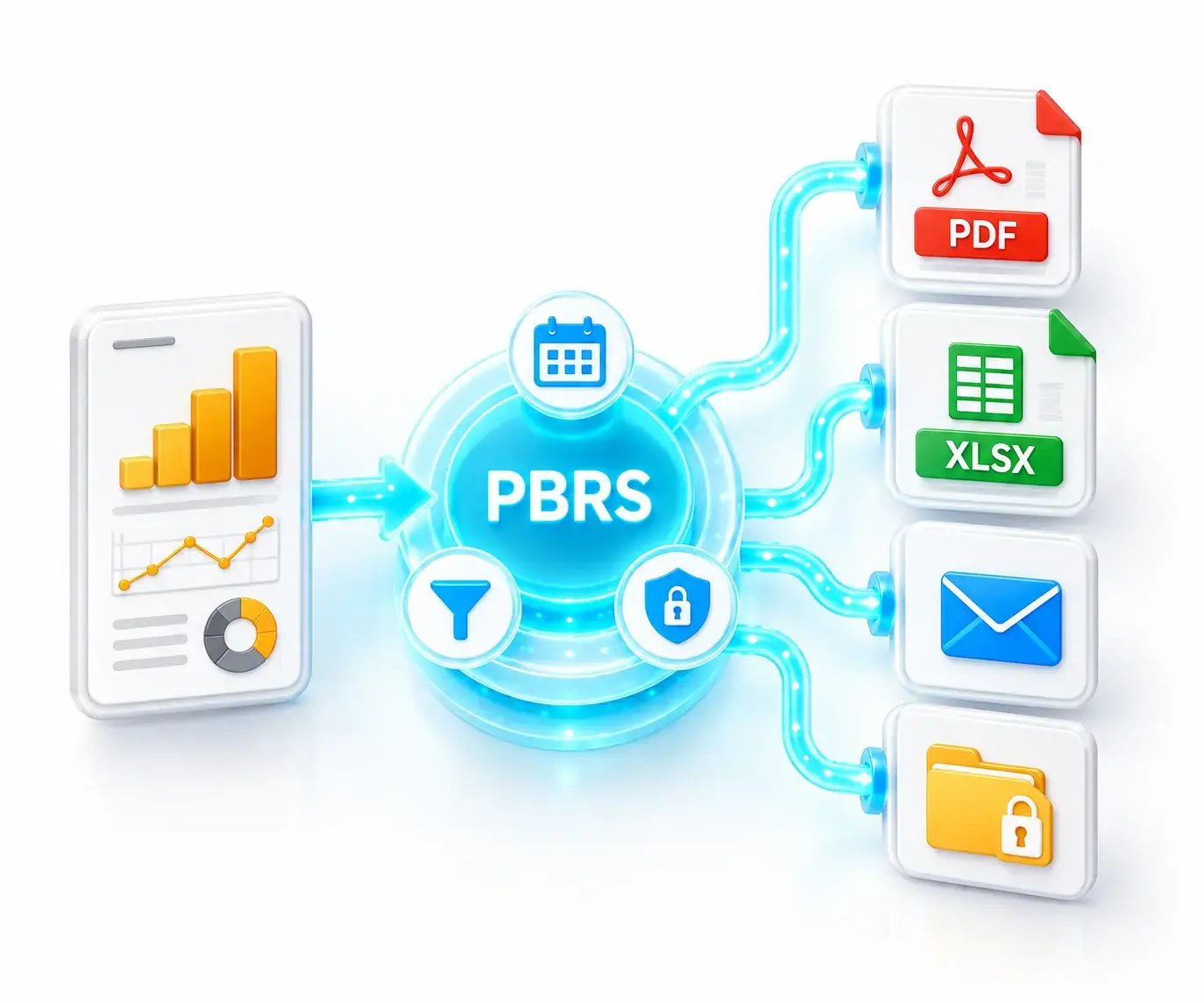
Power Automate can support straightforward report workflows. But advanced Power BI report automation—including recipient-specific exports, report packages and unattended delivery—can require APIs, loops, conditions, external services and custom exception-handling logic.
01
Exports Bring API, Licensing and Capacity Requirements
Power BI export options can depend on the report type, Microsoft API, licensing and capacity configuration. Different export methods can also have separate format, frequency and processing limitations.
02
Every Recipient Adds More Workflow Logic
Different filters, parameters, formats, filenames, messages, security settings and destinations can require variables, loops, conditions and additional branches for every reporting scenario.
03
Report Packaging Requires Custom Assembly
Generating several reports, waiting for every export, merging files, creating tabbed workbooks or ZIP archives and delivering the completed package together requires additional orchestration.
04
Production Reliability Requires More Development
Failed exports, incomplete packages, retries, alerts, logging and exception handling require more actions and testing—and create more workflow components that must be monitored and maintained.
Purpose-Built Report Automation
Power BI Reporting Capabilities Power Automate Does Not Provide Out of the Box
PBRS provides configurable report-generation, packaging, document-processing and delivery functions that would otherwise require additional Power Automate actions, APIs, external services or custom workflow logic.
Standard Multi-Report Packages
Run several reports from one package schedule, control their filters, parameters, formats and processing order, and deliver every completed output together.
Data-Driven Report Packages
Use database or JSON data to determine each package’s reports, filters, formats, recipients, messages and destinations automatically.
Combined PDF Documents
Merge multiple reports into one ordered PDF document and include bookmarks that help recipients navigate the completed report package.
Tabbed Excel Workbooks
Combine related report outputs into one Excel workbook and place each report or dataset on its own clearly identified worksheet tab.
Multiple Attachments in One Email
Generate several related reports and deliver all the finished files as separate attachments in one personalized email.
ZIP Files Created Before Delivery
Compress selected report outputs into a ZIP archive before sending the package by email or delivering it to another supported destination.
Advanced Visual-Data Exports
Export summary or underlying data from supported Power BI visuals to formatted or data-only Excel, with data-only PDF options where supported.
Monitoring and Exception Handling
Monitor unattended reporting workflows with schedule history, notifications, configured exception handling and retry processes.
Report Package Automation
Generate, Assemble and Deliver Complete Report Packages
PBRS can run multiple reports, control every report independently, assemble the completed outputs and deliver everything together. Standard and data-driven package schedules replace the custom loops, file handling and assembly logic required to build report packages in Power Automate.
01
Select Multiple Reports
Include Power BI, Power BI Paginated, Power BI Report Server or SSRS reports in one coordinated package schedule.
02
Configure Every Report
Control each report’s filters, parameters, format, filename and processing order independently within the package.
03
Assemble the Finished Package
Keep reports as separate files, create a ZIP archive, merge them into one ordered PDF or build one Excel workbook with separate worksheet tabs.
04
Personalize Every Package
Use database or JSON data to determine the reports, filters, formats, filenames and package contents required for every recipient.
05
Deliver Each Package
Send multiple files in one email or route each completed package to its assigned cloud-storage folder, FTP, SFTP or network destination.
Advanced Power BI Outputs
Create the Report Outputs Power Automate Leaves You to Build
PBRS handles report export, visual-data extraction, format selection, file naming and document creation as configurable reporting functions. Generate the output each recipient needs without building separate Power Automate actions and processing logic for every format.
Export Complete Reports to Multiple Formats
Generate complete Power BI reports in PDF, Excel, CSV and other supported output formats from the same reporting workflow.
Export Data From Power BI Visuals
Export summary or underlying data from supported Power BI visuals instead of limiting every workflow to a complete report-page export.
Create Formatted or Data-Only Excel Files
Preserve supported visual formatting in Excel or generate a clean data-only file for analysis, reconciliation and downstream processing.
Generate Data-Only PDF Output
Produce PDF output focused on the required report data where supported, without recreating the export through custom document-processing actions.
Control Every Output Dynamically
Assign formats, filenames, filters, parameters and other export settings separately for every recipient, report or data-driven package.
Data-Driven Package Automation
Create a Complete Report Package for Every Recipient Automatically
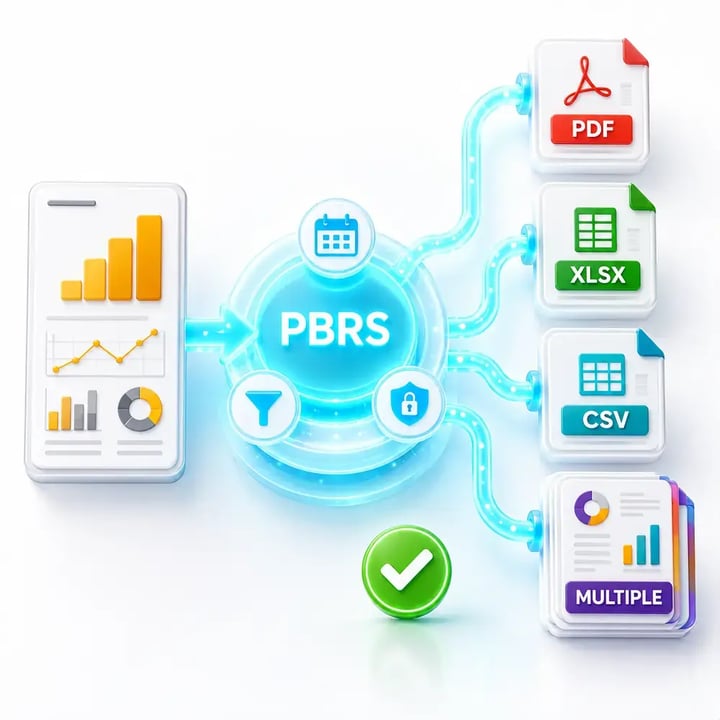
One PBRS data-driven schedule can read database or JSON records and generate, assemble and deliver a different report package for every customer, account, department or location. Build recipient-specific reporting workflows without creating another Power Automate branch for every variation.
Determine Package Contents From Your Data
Use each database or JSON record to determine which reports, visuals and package components PBRS generates for that recipient.
Apply Recipient-Specific Filters and Parameters
Generate the appropriate report content for every customer, account, department, region or location using dynamic filters and parameters.
Control Formats, Filenames and Security
Assign the required output formats, filenames, passwords and supported document-security settings separately for every generated result.
Assemble Every Recipient’s Finished Package
Keep files separate, create a ZIP archive, merge reports into one ordered PDF or build an Excel workbook containing separate worksheet tabs.
Deliver Each Package Using Its Own Instructions
Dynamically populate recipients, email subjects, messages and destinations, then deliver every completed package using the instructions in its source record.
Multi-Destination Report Delivery
Deliver Every Report and Package Through One Controlled Workflow
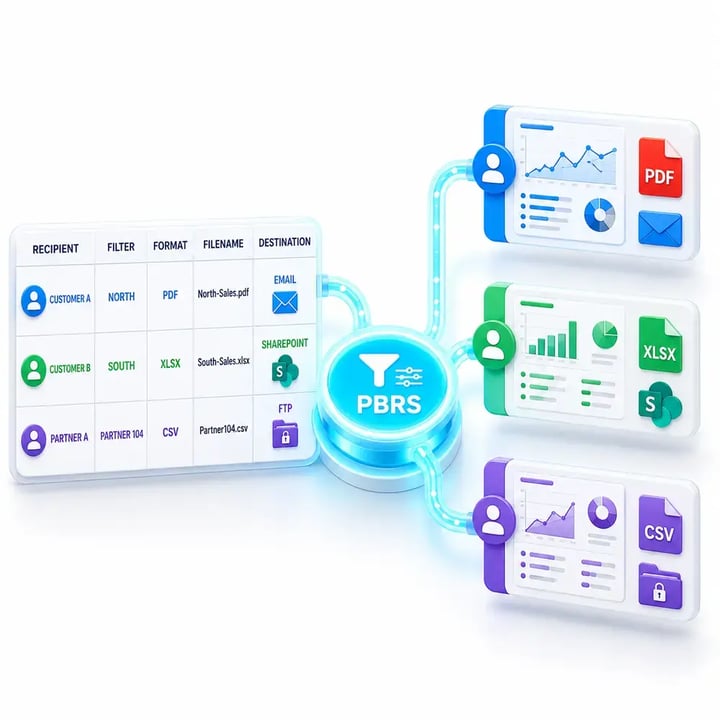
PBRS includes file grouping, personalization and delivery within the same workflow used to generate your reports. Send individual outputs or complete report packages to the required recipients and destinations without creating separate Power Automate branches for every delivery method.
Send Multiple Reports in One Email
Generate several related reports and deliver all the finished files as separate attachments in one personalized email.
Compress Reports Before Delivery
Combine selected outputs in a ZIP archive automatically and deliver the compressed package by email or another supported destination.
Deliver to Email, Collaboration and Storage Platforms
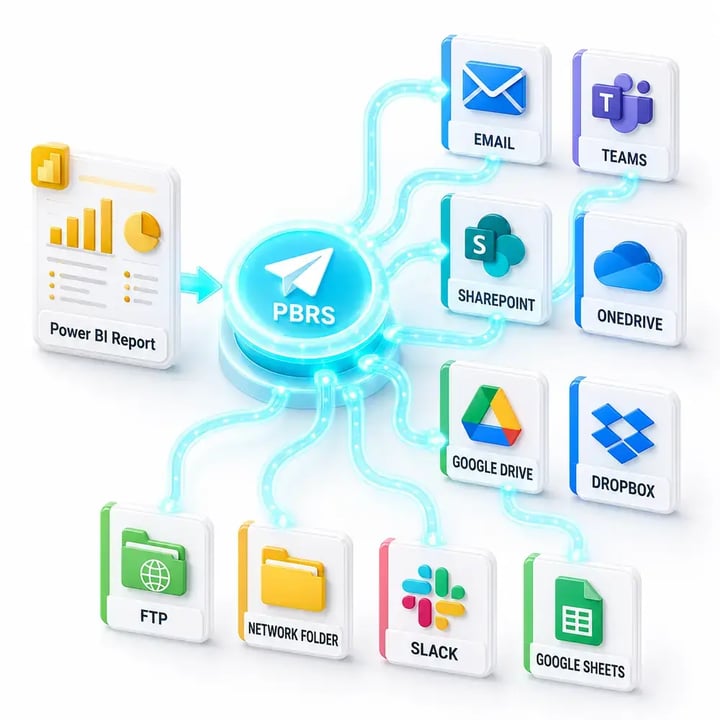
Deliver finished reports through email, Teams, SharePoint, OneDrive, Google Drive, Dropbox, FTP, SFTP, network folders and other supported destinations.
Route Each Package to a Dedicated Destination
Send each customer’s, department’s or location’s completed package to its assigned recipient, cloud-storage folder or secure file location.
Personalize Every Delivery Instruction
Dynamically control To, CC and BCC recipients, email subjects, message content, filenames and delivery destinations from database or JSON data.
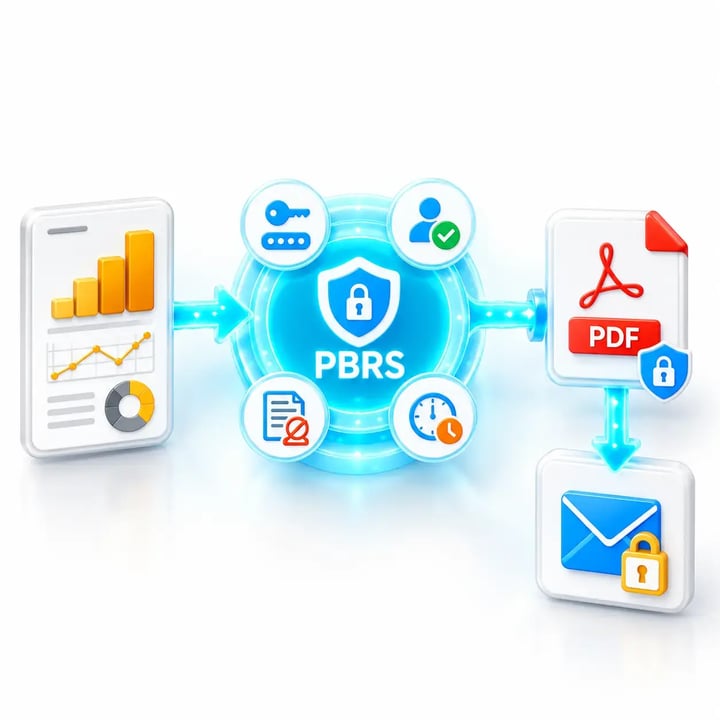
Built-In PDF Security
Secure Power BI PDF Delivery Without Extra Flow Steps
PBRS applies PDF protection after report generation and before delivery within the same automated workflow. Protect individual reports or complete PDF packages without adding separate security actions to a Power Automate flow.
Password-Protect PDF Reports Automatically
Apply a standard password or assign a different password dynamically for each recipient or generated PDF.
Control Document Permissions
Define whether recipients can print, copy, edit or otherwise modify the delivered PDF document.
Add Watermarks and Stamps
Apply visible watermarks or stamps before delivery to identify, classify or control distributed documents.
Apply Expiry and Metadata Controls
Configure document-expiry settings and populate supported PDF metadata such as title, author, subject and keywords.
Personalize Security for Every Recipient
Use data-driven settings to apply the appropriate passwords, permissions and document controls to each PDF report or package.
Scheduled and Event-Driven Automation
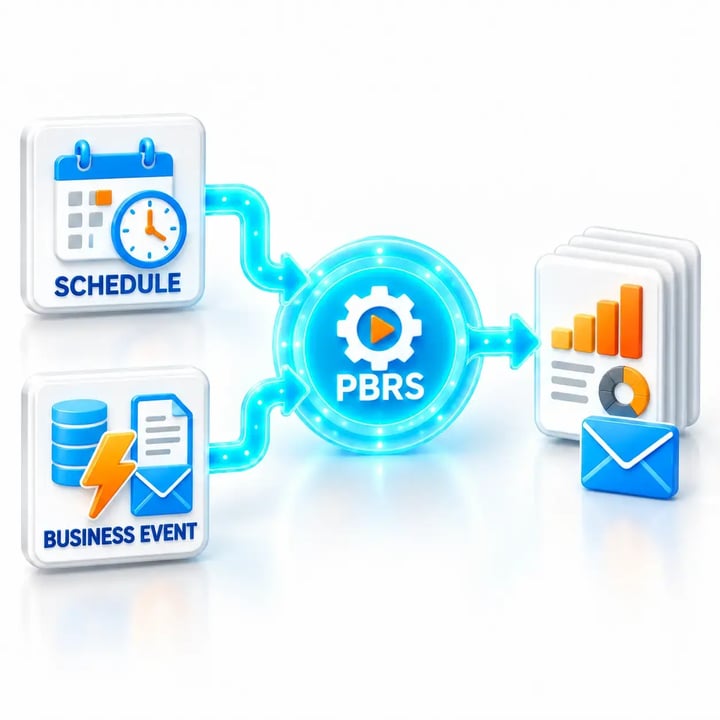
Schedule Power BI Automation—or Trigger It When Something Happens
Run individual Power BI reports or complete multi-report packages on a recurring schedule, a custom business calendar or a qualifying business event. Configure scheduling, triggers and dataset refresh directly in PBRS without building a separate Power Automate flow.
Use Recurring Schedules and Custom Calendars
Run reports hourly, daily, weekly, monthly or according to custom business and fiscal calendars.
Respond to Database Events
Start a reporting workflow when qualifying database records are created, modified or deleted.
Trigger Reports From Files, Emails or Data
Run reports when a file appears or changes, an unread email arrives or data is received on a monitored port.
Coordinate Power BI Dataset Refresh
Refresh supported Power BI datasets before report generation, after completion or at both points in the workflow.
Trigger Individual Reports or Complete Packages
Use the same schedule or business event to generate, assemble and deliver every required report output.
Unattended Reporting Operations
Know When Reports Succeed—and What Happens When They Do Not
PBRS provides the operational controls required to run report automation unattended. Monitor report generation and delivery, respond to exceptions and maintain a record of completed and failed processes without building separate Power Automate actions for every outcome.
Run Reporting Workflows Unattended
Use the PBRS Windows service to run scheduled and event-triggered reporting workflows without keeping the desktop application open.
Detect Export and Delivery Failures
Identify when a report cannot be generated, a package is incomplete or a completed output does not reach its required destination.
Apply Exception-Handling Rules
Configure how PBRS responds when reports return no data, exports fail, files are unavailable or delivery conditions are not met.
Retry Qualifying Failed Processes
Apply configured retry behavior to qualifying failures instead of requiring someone to identify and restart every failed workflow manually.
Send Status and Exception Notifications
Notify the appropriate people when schedules succeed, fail or encounter exceptions that require investigation.
Maintain Reporting History
Review schedule activity and processing results to understand what ran, what completed and which reports or packages require attention.
Go Beyond Power Automate
What PBRS Adds to Power BI Report Automation
PBRS provides advanced report-generation, packaging, document-processing and delivery capabilities as configurable functions. Reproducing these outcomes in Power Automate can require APIs, custom code, external services, branching logic and ongoing maintenance.
Custom Workflow Development
Building It in Power Automate
Multi-Report Packages
Requires loops, export-status checks, file handling and coordination before several reports can be delivered together.
Data-Driven Packages
Recipient-specific reports, formats and destinations require data retrieval, iteration, variables, conditions and branching logic.
Combined PDFs
Merging several exports into one ordered PDF with navigation can require custom code, connectors or an external document service.
Tabbed Excel Workbooks
Creating one workbook with separate report tabs requires additional workbook creation and file-manipulation logic.
Multiple Email Attachments
The flow must generate every report, retain each file and construct the attachment collection before sending the email.
ZIP Creation
Compressing selected reports before delivery can require custom archive processing or another service and connector.
Advanced Data Exports
Formatted and data-only exports from visuals can require different APIs, scripts or report-specific processing paths.
Security and Destination Rules
Recipient-specific passwords, permissions and delivery destinations add more conditions, connectors and actions.
Event-Triggered Reporting
Business events can start a flow, but the complete report-generation, packaging and delivery process must still be designed.
Exceptions, Retries and History
Failure handling, retry policies, notifications and reporting history must be added and maintained within each flow.
Purpose-Built Report Automation
Configure It in PBRS
Multi-Report Packages
Add multiple reports to one package schedule, control their processing order and deliver the completed outputs together.
Data-Driven Packages
Use database or JSON data to generate a different set of reports, formats, messages and destinations for every recipient.
Combined PDFs
Merge reports into one ordered PDF and include bookmarks that help recipients navigate the completed package.
Tabbed Excel Workbooks
Create one Excel workbook containing separate, clearly identified worksheet tabs for the required reports or datasets.
Multiple Email Attachments
Generate several reports and include every finished file as a separate attachment in one personalized email.
ZIP Creation
Compress selected report outputs into a ZIP archive automatically before email or destination delivery.
Advanced Data Exports
Export summary or underlying visual data to formatted or data-only Excel, with data-only PDF options where supported.
Security and Destination Rules
Configure passwords, document permissions, recipients and supported delivery destinations for each generated result.
Event-Triggered Reporting
Start complete reporting workflows from database, file, email and other qualifying business events.
Exceptions, Retries and History
Use configured exception handling, retry behavior, notifications and schedule history to operate reporting workflows unattended.
PBRS turns advanced Power BI report delivery into a configured reporting workflow—not a custom automation-development project.
Real-World Reporting Automation
Where PBRS Replaces Complex Power Automate Reporting Workflows
Organizations use PBRS when report delivery requires more than exporting one report and sending one email. These workflows combine report generation, personalization, file assembly, delivery and operational control.
01
Customer-Specific Report Packages
Generate the required reports for every customer, apply customer-specific filters, assemble the finished files and deliver each package in one email or dedicated destination.
02
Board Books and Management Packs
Run several financial, operational and management reports, control their order and merge them into one bookmarked PDF or tabbed Excel workbook.
03
Automated Excel Data Delivery
Export summary or underlying visual data to formatted or data-only Excel and distribute it to teams that need working data rather than dashboard access.
04
Event-Triggered Reporting With Exception Handling
Start reporting after a database, file or email event, refresh the required dataset, generate and deliver the outputs, and notify administrators when something fails.
Power BI and Reporting Compatibility
Works with Your Power BI Environment
Use PBRS to automate report generation and delivery across supported Microsoft Power BI and reporting environments—without rebuilding your reporting infrastructure.
Power BI Service
Automate applicable Power BI Service reporting scenarios, including supported Power BI Pro and Premium Per User configurations.
Power BI Paginated Reports
Schedule parameter-driven paginated reports and export complete datasets to PDF, Excel, CSV and other supported formats.
Power BI Report Server
Automate reports hosted in your on-premises Power BI Report Server environment while retaining control of your reporting infrastructure.
SQL Server Reporting Services
Schedule, export, package and distribute on-premises SSRS reports alongside your broader Power BI reporting workflows.
Supported functionality and licensing requirements depend on the report source, authentication method and deployment configuration.
Trusted Report Automation for More Than 20 Years
ChristianSteven Software has helped organizations around the world automate business intelligence reporting and dependable report delivery for more than two decades. Every active PBRS subscription includes unlimited technical support, current and future functionality and product upgrades at no additional cost. When a customer requests an enhancement and ChristianSteven adds it to PBRS, that enhancement is also included at no additional cost.
Frequently Asked Questions About Automating Power BI Without Power Automate
Get answers about licensing, scheduling, report exports, personalization and delivery with PBRS.
PBRS provides purpose-built functions for scheduling, exporting, personalizing, packaging, securing and delivering Power BI reports. Capabilities such as data-driven report packages, combined PDFs, tabbed Excel workbooks, ZIP creation, multiple reports in one email, recipient-specific security and reporting exception management can be configured in PBRS without developing a separate collection of Power Automate actions, loops and branches.
Yes. A PBRS package schedule can run multiple Power BI, Power BI Paginated, Power BI Report Server or SSRS reports from one workflow. Each report can have its own filters, parameters, format, filename and processing order before PBRS assembles and delivers the completed outputs together.
A data-driven package uses database or JSON data to determine what PBRS generates for each customer, recipient, department, account or location. Each record can control the reports included, filters, parameters, formats, filenames, security settings, recipients, messages and destinations, allowing PBRS to create and deliver a different finished package automatically for every record.
Yes. PBRS can merge multiple reports into one combined PDF in the required order and include bookmarks to help recipients navigate the document. It can also combine related report outputs into one Excel workbook with each report or dataset placed on a separate worksheet tab.
Yes. PBRS can generate several reports and deliver them as separate attachments in one personalized email. It can also compress selected outputs into a ZIP archive automatically before sending the package by email or delivering it to another supported destination.
Yes. PBRS can export summary or underlying data from supported Power BI visuals to Excel. Depending on the report and export method, the output can preserve supported formatting or be generated as a data-only file for analysis, reconciliation or downstream processing.
PBRS provides execution history, status notifications and configurable exception-handling and recovery options for unattended reporting workflows. Administrators can identify failed exports, incomplete packages and delivery problems, notify the appropriate people and apply configured retry or recovery behavior when qualifying processes fail.
Not in every supported scenario. PBRS supports applicable Power BI Pro and Premium Per User configurations using alternative report-generation methods rather than relying exclusively on Microsoft’s Export to File API. The licensing and configuration required depend on the report type, report source, authentication method and deployment environment.
In many reporting scenarios, yes. When a Power Automate flow primarily schedules or triggers reports, applies filters, creates exports, assembles files, adds security and delivers the results, those steps can often be consolidated into a centrally managed PBRS workflow. Any non-reporting processes performed by the existing flow should be reviewed separately.
Yes. PBRS can run reports hourly, daily, weekly, monthly or according to custom business and fiscal calendars. It can also start reporting workflows when qualifying events occur, including database changes, file creation or modification, unread emails and data received through a monitored port.
Ready to Automate Power BI Reporting Without Power Automate?
Schedule, personalize, export, secure and deliver Power BI reports from one PBRS workflow — without building and maintaining separate Power Automate flows.