

Power BI Report Server Email Delivery for PBIX and Paginated Reports
Power BI Report Server supports native email subscriptions for paginated reports, but not PBIX Power BI reports. For a PBIX report, an applicable tool such as PBRS can render the required pages and email the finished file. Setting up the server’s SMTP connection does not add PBIX subscriptions.
Suppose you need a monthly invoice PDF and a daily operations PDF. Identify each report’s type first, then use the right delivery route. The workflow below covers Report Server; cloud Power BI Service subscriptions use different instructions.
- THE DIRECT ANSWER Choose the Delivery Route from the Report Type
- REQUIREMENTS AND LIMITATIONS Prepare Unattended Execution and the Mail Connection
- END-USER WORKFLOWS Set Up the Invoice and Operations Emails
- DEVELOPER AND API WORKFLOWS Retain the Source, File and Delivery Evidence
- CHOOSE YOUR NEXT STEP Enable Recurrence After the Required Output Passes
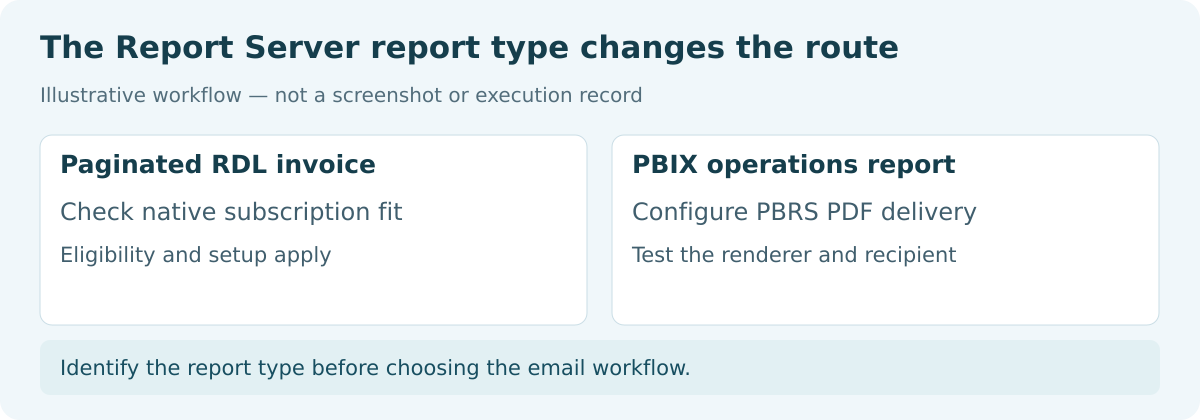
Choose the Delivery Route from the Report Type
Identify the report type before choosing the email workflow.
Use a native paginated subscription for the invoice PDF. For the PBIX operations report, configure a PBRS on-premises report schedule to render and email the required pages; native Report Server does not offer PBIX email subscriptions.
Your Report Server portal may hold both an RDL invoice report and a PBIX operations report. The invoice is paginated—a report designed for fixed pages and detailed documents. The PBIX report is a Power BI report with visual pages. Their location in one portal does not give them the same email options.
Microsoft’s Report Server comparison confirms these report-type boundaries. PBRS supplies the scheduled rendering and email step for the operations example, rather than requiring someone to prepare and send its PDF every day.
Check RDL or PBIX first
Choose the email route from the report type before changing mail settings. A native paginated subscription is a valid option for the invoice. A missing PBIX subscription button is not an SMTP fault.
Define the finished result
A portal link takes an authorized reader to a report. A PDF is a finished copy. If the manager needs an attachment, a successful email containing only a link does not complete the job.
Read product menu labels in context
Report Server does not provide native cloud-style dashboards. PBRS’s desktop menu says “Dashboards & Reports,” but that product label does not change the Report Server feature boundary.
Start with a controlled example
The invoice and operations scenario here is illustrative. Use approved test recipients and compare received files with a manual baseline. No customer Report Server or PBRS run has been performed for these examples.
Prepare Unattended Execution and the Mail Connection
Compare the same recurring obligation: which report must arrive, which account can read it, and who maintains its schedule and mail connection. The invoice and operations PDFs need different routes even though they share a portal.
| Recipient requirement | Native Report Server | Applicable PBRS route |
|---|---|---|
| RDL invoice PDF | Paginated email subscription with the chosen rendering format. | SSRS/paginated schedule when you need additional delivery control. |
| PBIX operations PDF | No native PBIX email subscription. | On-premises PBIRS report schedule with selected pages and an Email destination. |
| Portal link | Include Link for a paginated subscription; the recipient still needs report access. | Include the report URL where appropriate; access remains separate from receiving a file. |
| Unattended access | The paginated job needs valid data-source credentials and parameters; SQL Server Agent handles its schedule. | PBRS needs its configured report identity and scheduling service to reach the source without your browser session. |
| Mail ownership | Report Server’s email extension uses the administrator’s configured sender and SMTP connection. | The PBRS Email destination uses its own configured sending account or server. Test that mail path separately. |
| Repeat output and delivery | Maintain each native paginated subscription’s report format, parameters and recipients. | Keep the operations report’s selected pages, filters, destination format and timing together in the PBIRS schedule. |
A native paginated subscription must run without someone signing in. Use stored or no credentials and valid parameter defaults, and confirm SQL Server Agent is running. Your assigned role controls whether you can manage your own subscriptions or all subscriptions for a report. Review the web portal requirements first.
For an invoice that already fits native delivery, keep that subscription. PBRS adds a scheduled file-and-email workflow for the PBIX operations report, with output settings retained for the next morning.
Prove unattended report access
A report that works while you are signed in may fail in a scheduled run. Confirm the configured credentials can read the data and that parameter defaults remain valid.
Check the scheduling service
Native subscriptions depend on SQL Server Agent. Confirm it is running before diagnosing an absent email. Also check that the subscription owner’s role permits the required setup.
Keep the mail paths separate
The native email extension serves Report Server subscriptions. PBRS has its own mail configuration and destination settings. A successful send through one does not prove the other uses the same account, sender or relay.
Keep secrets out of run records
Record the configured identity and server name as operational references. Store credentials through the application’s approved controls, rather than putting them in examples or exported job manifests.
Set Up the Invoice and Operations Emails
Prepare the native invoice mail connection
An administrator can configure the native email extension in Report Server Configuration Manager:
- Connect to the intended Report Server instance and open E-mail Settings.
- Set Sender Address to an address the configured account is allowed to send from.
- Set SMTP Server to the approved server or relay. Choose an authentication method supported by both ends.
- If authenticating with the report server service account, confirm its Send As permission. Select Apply and retain the approved configuration for testing.
The Configuration Manager guide explains these controls. Check the mail service’s current requirements; a hosted mailbox may not accept a legacy username-and-password connection.
Schedule the invoice and operations reports
For the invoice, manually render the required month and check its detail and totals. Then create the native paginated subscription:
- In the report’s ellipsis menu, choose Manage > Subscriptions > + New Subscription.
- Select Standard and the Report Server email delivery extension. Supply an approved test recipient.
- Choose Include Report and a Render Format such as PDF. Add Include Link only if the link is also needed.
- Set the intended parameter values and schedule. Save, then use Run now for the controlled test.
- Read the Result column. Open the received attachment and compare its month, invoice identifiers, totals and page sequence with the baseline.
The native portal workflow shows these controls. The email delivery guide distinguishes notifications, links and attached or embedded output. One native subscription cannot place several separate reports in a single email.
For the PBIX operations report in the PBRS Web Application, choose New Schedule > PBIRS Report Schedule. Select the configured Power BI account and report, then verify its Virtual Directory and Report Path. Set the start date, frequency and time; leave Enable this Schedule unchecked during preparation.
Choose rendering settings and actual page titles in Pages To Render. Separate multiple titles with a pipe, such as Operations|Exceptions. These are example titles; use names that exist in your report. A blank field renders the currently selected page, not all pages.
For a required filter, enter its Table/Column Target, Value and matching Type, then click Add. Add an Email destination, select its output format and approved test mailbox, review and save the configuration, then perform a manual test before enabling recurrence. Follow the web application guide for the exact screens.
In the desktop application, use Single > PowerBI on Premise > Dashboards & Reports instead. The desktop wizard has its own labels. The Email destination guide covers recipients, subject, body and report attachment settings.
Inspect the invoice from beginning to end
Write down the expected month and invoice identifiers. Check the first and last invoice, total and page sequence in the received PDF so stale parameters or an incomplete file are easier to spot.
Check attachment choices before the schedule
If only a link arrives, inspect Include Report and Render Format. If rendering fails, investigate report credentials and parameter values before treating it as a mailbox problem.
Check both operations pages
Open the generated PBIX output and verify the actual Operations and Exceptions pages, required values and reporting date. Then inspect the received attachment. A mail handoff alone does not prove the PDF contains the intended pages.
Verify the actual mail path
Check sender, recipient and destination evidence for each route. Keep native and PBRS tests separate so a working invoice email does not conceal a failure in the daily operations schedule.
Retain the Source, File and Delivery Evidence
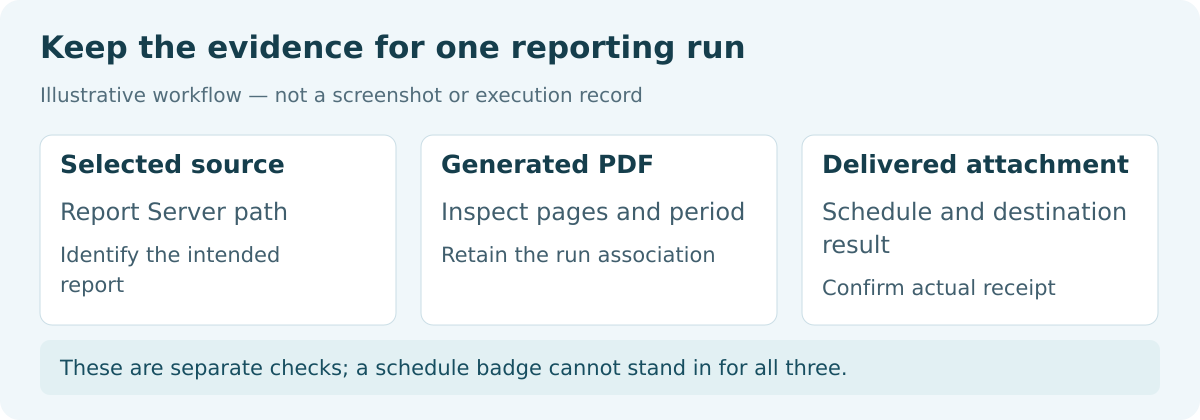
These are separate checks; a schedule badge cannot stand in for all three.
Optional technical section. Keep a run record that links the selected Report Server source with the expected file and destination. For the PBIX operations example, retain the following information:
Illustrative acceptance record
sourceType: PBIX on Power BI Report Server
reportPath: actual selected server path
requiredPages: actual Operations and Exceptions titles
expectedPeriod: approved reporting date
outputFormat: PDF
checks: both page identities, required values, no render error
destination: approved controlled mailbox
evidence: generated file, schedule result, received attachment
This is an acceptance specification, not evidence of an executed job. Retain the actual generated file, schedule result and received attachment for the reporting date you test.

Record the selected source
Keep the report path and configured on-premises account with the run. Confirm source access through that identity, rather than relying on your own browser session.
Keep page and filter settings explicit
Record the actual page titles and the field, value and type used for each filter. Recheck them after report changes, including renamed pages, and inspect the file for render errors.
Separate generation from receipt
The generated file establishes what was rendered. The destination result and received attachment establish what was delivered. Retain both stages; one successful status cannot prove the contents of the other.
Review uncertainty before retrying
Investigate an uncertain delivery before creating another copy. Keep evidence for the current reporting date so an older successful PDF is not mistaken for the latest result.
Enable Recurrence After the Required Output Passes
Use native subscriptions when one paginated report, its rendering options and the configured email extension meet the requirement. For PBIX email delivery, use the verified PBRS on-premises route and select the required pages.
Before enabling recurrence, keep an approved output and delivery evidence for each report type. Check sender, recipient, scope and period. That baseline gives you something concrete to compare when a later run fails.
Explore Power BI Report Automation. Technical sources reviewed: 9 October 2026.
Considering PBRS for Power BI Report Server delivery? Share the guide with your colleagues to review deployment, licensing, security and your reporting requirements.
Contributors:
Christian Ofori-Boateng
CEO, ChristianSteven Software

