POWER BI QUESTIONS

How to Schedule Power BI Excel Reports by Email

For a recurring Excel attachment, use a paginated Power BI subscription or a PBRS schedule that exports selected visual data. Standard report subscriptions do not attach XLSX workbooks.

PBRS can turn the rows finance needs into a scheduled workbook email, so you can stop repeating the export, file preparation and sending each week.

  
THE DIRECT ANSWER

Choose the Excel Output Recipients Actually Need

Use a paginated subscription when the report already produces the Excel file you need. For rows from a standard Power BI visual, PBRS can export the selected data to an XLSX workbook and email it on a schedule.

Imagine finance starting Monday with a Customer Balances workbook. The analyst needs to sort customers, total their balances and find accounts to follow up. A picture of the report cannot do that job; usable rows can.

Choose the native route for an existing paginated workbook

A paginated report is designed around a fixed page layout, including headers and grouped detail. If it already renders the required spreadsheet, open it in the Power BI service, set its parameters and create a subscription. Select Excel Workbook as the attachment format.

Your organisation must allow subscriptions and that export format. Report access and recipient eligibility still apply, and the attachment has a 25 MB ceiling. Microsoft’s subscription guidance explains those conditions.

Choose PBRS for a workbook from selected visuals

PBRS, ChristianSteven’s report automation software, offers MS Excel Data Only output. Choose the report page, titled visual and data-export mode, then add an Email destination. Finance gets workbook data it can sort and reuse, while you maintain one recurring export-and-email job.

The PBRS web workflow shows these controls. The report account still needs permission to access and export the data.

Excel Online can open or store the resulting file. It does not add an XLSX attachment option to a standard Power BI subscription, whose preview is an image and full-report attachments are PDF or PowerPoint.

Give readers usable rows

Choose data output when the recipient needs to sort balances or calculate totals. Keep the purpose of the workbook clear before choosing its format.

Keep the intended report layout

For an invoice with headings and grouped detail, a paginated report may be the right starting point. Its Excel output follows the report’s rendering layout.

Send a genuine workbook

Open the attachment in Excel. An image or a file renamed with an .xlsx extension is not an editable workbook.

Choose where readers will open it

Excel Online is a reading or storage choice. Decide how to generate the workbook separately from where recipients will use it.

  
REQUIREMENTS AND LIMITATIONS

Compare Workbook Routes Before Scheduling

Compare the output around finance’s weekly task. The useful question is whether the recipient gets the right rows and structure, rather than whether an email happened to arrive.

Your requirement Microsoft route and boundary What PBRS adds
Rows to sort and total A standard report subscription sends a preview, or an eligible PDF/PowerPoint attachment. It does not send XLSX. MS Excel Data Only exports data from selected report visuals into a workbook.
A formatted paginated workbook A paginated subscription can attach rendered XLSX, subject to parameters, access, enabled formats and the 25 MB ceiling. A reporting schedule can combine the selected output with recurring delivery. Choose the settings for the actual report type.
A workbook built from query rows A maintained flow can query data and write it to Excel using separate data and workbook actions. Visual selection, workbook output, template placement and email delivery can be maintained together.
Access to the source data The standard-report Export to File API generates PDF, PPTX or PNG, not XLSX. Other data routes have their own permissions and limits. The source account still needs authorised access. Templates do not bypass export permissions or source limits.

For the API formats, see Microsoft’s standard-report export documentation.

Describe the workbook in everyday terms

For this example, the Balances sheet should contain one row per customer, with CustomerCode, CustomerName, Balance and AsOfDate. Keep customer codes as text so leading zeros survive. Keep balances numeric so Excel can total them.

Every row should show the intended reporting date. Compare the workbook’s row count and balance total with the source under the same filters and period. A matching total alone cannot prove that every expected customer is present.

If finance uses an existing template, choose the worksheet and where the data starts. PBRS’s Excel output guide documents template placement and column formatting.

Say what one row means

For customer balances, agree whether one row represents a customer or an individual invoice. Counts make sense only when both files use the same level of detail.

Keep numbers and identifiers distinct

Customer codes are labels, even when they contain digits. Store them as text; keep Balance numeric for calculations.

Use the completed data update

Plan delivery after the required refresh succeeds. A later clock time alone cannot establish that the data is ready.

Choose the workbook audience

Confirm who may receive the exported data before adding email addresses. A spreadsheet copy can be saved or forwarded independently of the live report.

  
END-USER WORKFLOWS

Build and Verify a Weekly Workbook Email

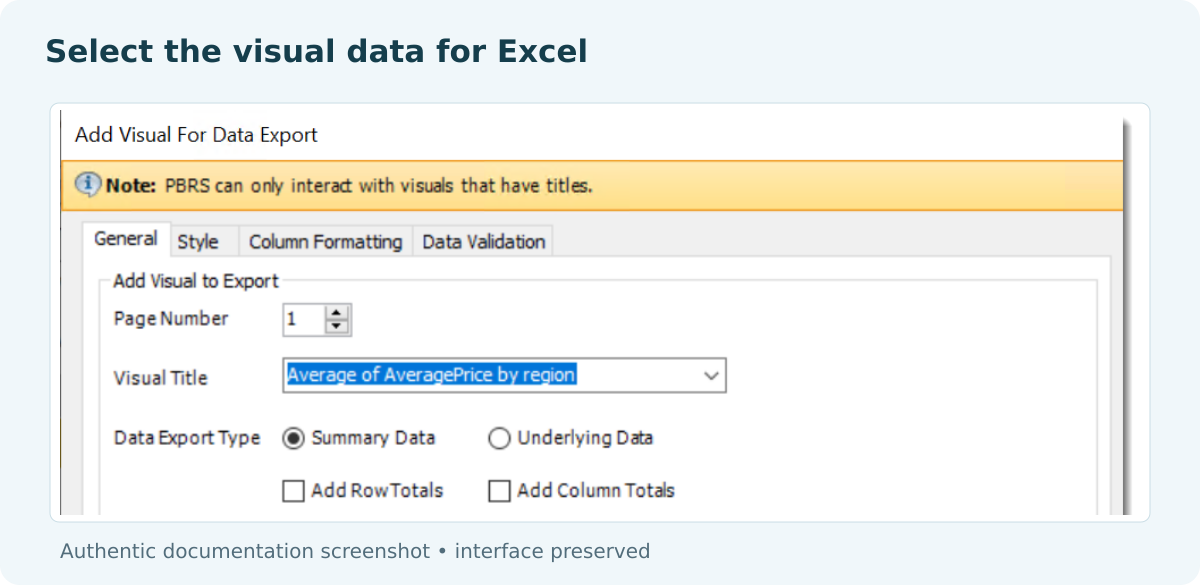
PBRS visual-data options showing Visual Title and summarized or underlying data choices.

Documentation example: select Customer Balances when configuring this article’s workbook.

Here is an illustrative weekly setup for the Customer Balances workbook. Use your own report, account and approved test recipient.

  1. Select the report. Create a single Power BI report schedule named Weekly customer balances — XLSX. Choose the account, workspace and report. Keep automatic execution disabled during setup.
  2. Set the timing. Choose the weekday, time and time zone. Arrange the run after the required data update has completed successfully.
  3. Add the workbook email. Add an Email destination named Finance workbook. Select MS Excel Data Only (*.xlsx), then enter the test recipient, subject and message.
  4. Select the rows. In Format Options, add the visual data. Choose the page and the Customer Balances visual title. Use summarized data for the intended customer-level result. Underlying data provides a different level of detail and has its own access conditions.
  5. Place the data. Choose the worksheet and any template starting row and column. Use a period-specific file name, such as customer-balances-2026-10-05.xlsx, through your version’s naming controls.
  6. Open the delivered file. Save the destination and preview the output, then execute the full schedule to the test mailbox. Open the attachment in Excel and confirm the sheet, types, date, row count and total.
  7. Start recurring delivery. Enable the schedule once the file and delivery are correct. Record who owns the job and who investigates a failed run.

Follow the single-schedule guide, MS Excel Data Only setup and Email destination setup for your installed controls.

If the workbook needs attention

If Customer Balances is missing from the choices, confirm that the visual has a title in Power BI and that you selected the right page. If fewer rows arrive, compare the filters, export mode and source export limits before sending again.

Keep the first correct received workbook as a reference for later report changes. A successful mail submission does not show that the recipient opened the attachment; inspect the PBRS execution result and the mailbox separately.

Start with a test mailbox

Keep automatic delivery disabled while you inspect the first workbook. Send only to the approved test recipient until it is ready.

Compare like with like

Use the same reporting period and filters when comparing the workbook with the source. Check both customer count and balance total.

Recheck renamed visuals

A report update can change the visual title or page reference. Recheck the export selection before the next scheduled workbook.

Keep the delivered copy

Retain the first correct received attachment with the execution record. It gives you a practical reference when investigating a later difference.

  
DEVELOPER AND API WORKFLOWS

Orchestrate Workbook Delivery from an Application

An application can offer an authorised finance user a “Send customer balances” action. Your server maps that action to the approved PBRS schedule; PBRS generates and delivers the configured workbook.

This section is for the developer implementing the action. For scheduled delivery alone, continue to the next step.

Record the job and reporting period

The following is an illustrative application record, not a PBRS request schema:

Illustrative orchestration contract — not a PBRS request schema
job: weekly-customer-balances-xlsx
period: 2026-10-05
approvedScheduleId: <ID from your PBRS installation>
expectedSheet: Balances
expectedColumns: CustomerCode, CustomerName, Balance, AsOfDate

Authorise the caller and record the job-and-period key before requesting execution. That key helps your application reconcile repeated requests; it does not mean PBRS automatically prevents duplicate deliveries.

Call the documented execution operation, keep its ExecutionId and poll the status endpoint with a time limit. Inspect the execution result as well as status, then match it with the delivered workbook. The PBRS schedule lifecycle reference gives the operations and recovery rules.

Protect the workbook when the report changes

If a developer renames Customer Balances, verify the saved visual selection before releasing the report. Check the expected sheet names and column types after generation. A file can have the correct extension but the wrong date or an empty sheet.

Keep credentials on the server and accept only approved report and recipient choices. If the request times out, reconcile the retained execution ID before launching another run. Isolate different users’ configurations so one request cannot overwrite another’s workbook settings.

Map to an approved job

Resolve the finance action to a schedule maintained in PBRS. Authorise the caller for that job and its audience.

Track the reporting date

Record the period before execution. Use it when deciding whether a repeated request refers to the same workbook.

Validate the workbook shape

After generation, check the Balances sheet and its expected columns and types. These checks catch changes that a file-extension check misses.

Resolve an uncertain run

Inspect the existing execution before trying delivery again. A timeout does not establish that nothing was sent.

  
CHOOSE YOUR NEXT STEP

Put the Workbook Schedule into Recurring Use
If an existing paginated subscription already produces finance’s required XLSX, it may be enough. A maintained query-to-workbook flow can also fit an established automation.

Choose PBRS when selecting the visual, preparing the workbook and emailing it each week have become a recurring task. Keep the worksheet, template placement, timing and destination in one maintained schedule. Finance receives the rows it needs to work with, rather than a picture it must retype.

Start with the Customer Balances workbook. Confirm the sheet, numeric balances, complete intended customer rows and received attachment, then enable the schedule. Use that same reference when the report changes.

See how PBRS schedules Power BI reports to Excel. Explore Power BI Report Automation.

Technical sources reviewed: 8 October 2026.

Considering PBRS for scheduled Excel attachments? Share the guide with your colleagues to review deployment, licensing, security and your reporting requirements.

Download the PBRS Internal Evaluation Guide

Contributors:

Christian Ofori-Boateng

Christian Ofori-Boateng

CEO, ChristianSteven Software